



Whole-home humidity control
AprilAire Whole-Home Humidifiers
A portable humidifier treats one room and asks you to fill it. A whole-home humidifier treats the house, plumbs directly to your water supply, and runs off your existing HVAC system. Compass installs and services the full AprilAire humidifier line across the Fox River Valley.
Why an Illinois Winter Dries Your House Out
Cold air holds very little moisture. When that air comes inside and gets heated to seventy degrees, its relative humidity drops sharply. Forced-air heating then moves that dry air through every room in the house.
Indoor relative humidity in an Elgin, IL January routinely falls into the teens and twenties. For reference, that is drier than most desert climates.
You already know what that looks like:
- Static shocks every time you touch a doorknob
- Gaps opening between hardwood floorboards
- Furniture joints loosening and wood trim shrinking
- Pianos and guitars that will not hold tune
- Air that feels colder than the number on your thermostat
Turning the thermostat up does not fix any of it, because temperature is not the variable that changed. Moisture content is.
What balanced humidity actually means
The commonly cited comfort range is 40 to 60 percent relative humidity. In practice, in a cold climate, the right number for your house is usually toward the lower end of that range, and it shifts with the outdoor temperature.
The reason is condensation. On a night in the single digits, humidity that would feel perfect indoors will condense on your windows and, more importantly, inside exterior walls where you cannot see it. Every AprilAire automatic control accounts for this by adjusting the target as outdoor temperature falls.
This is the part portable units get wrong. They run until the tank empties, with no reference to what is happening outside.
Three Types, and How to Tell Which One Fits

Bypass evaporative
The most common style. A bypass duct routes warm supply air across a water panel, moisture evaporates into the airstream, and the humidified air returns to the system.
Models: AprilAire 400, 500, 600, and the new 620 with HydroCore technology.

Fan-powered evaporative
Same evaporative principle, with a built-in fan that pulls air across the water panel instead of relying on a bypass duct. Higher output than bypass units, and useful where there is no room to run a bypass.
Models: AprilAire 700, and the new 720 with HydroCore technology.

Steam
Generates its own moisture by boiling water, independent of whether your furnace is running. Steam is also the answer for homes without ductwork at all, including ductless and radiant systems.
Models: AprilAire 800, and the 865 with fan pack for ductless applications.
Self-contained option: The AprilAire 300 is a self-contained unit designed for homes without conventional ductwork.
The AprilAire Humidifier Line
| Model | Type | Best suited to |
|---|---|---|
| 300 | Self-contained evaporative | Homes without conventional ductwork |
| 400 / 400M | Bypass evaporative, drainless | Smaller homes; no drain required |
| 500 / 500M | Bypass evaporative | Small to mid-size homes |
| 600 / 600M | Large bypass evaporative | Mid-size to larger homes |
| 620A / 620M | Large bypass with HydroCore | Current generation; improved efficiency and less wastewater |
| 700 / 700M | Fan-powered evaporative | Larger homes, or where a bypass duct will not fit |
| 720A / 720M | Fan-powered with HydroCore | Current generation fan-powered |
| 800 | Steam | Any heating system; performance independent of furnace operation |
| 865 | Steam with fan pack | Ductless and non-ducted homes |
A note on the model suffixes. An "A" or no suffix indicates automatic control, which reads outdoor temperature and adjusts the humidity target as conditions change. An "M" indicates manual control, which you set yourself and adjust seasonally. In a climate with our temperature swings, automatic is worth it.
What HydroCore Changes
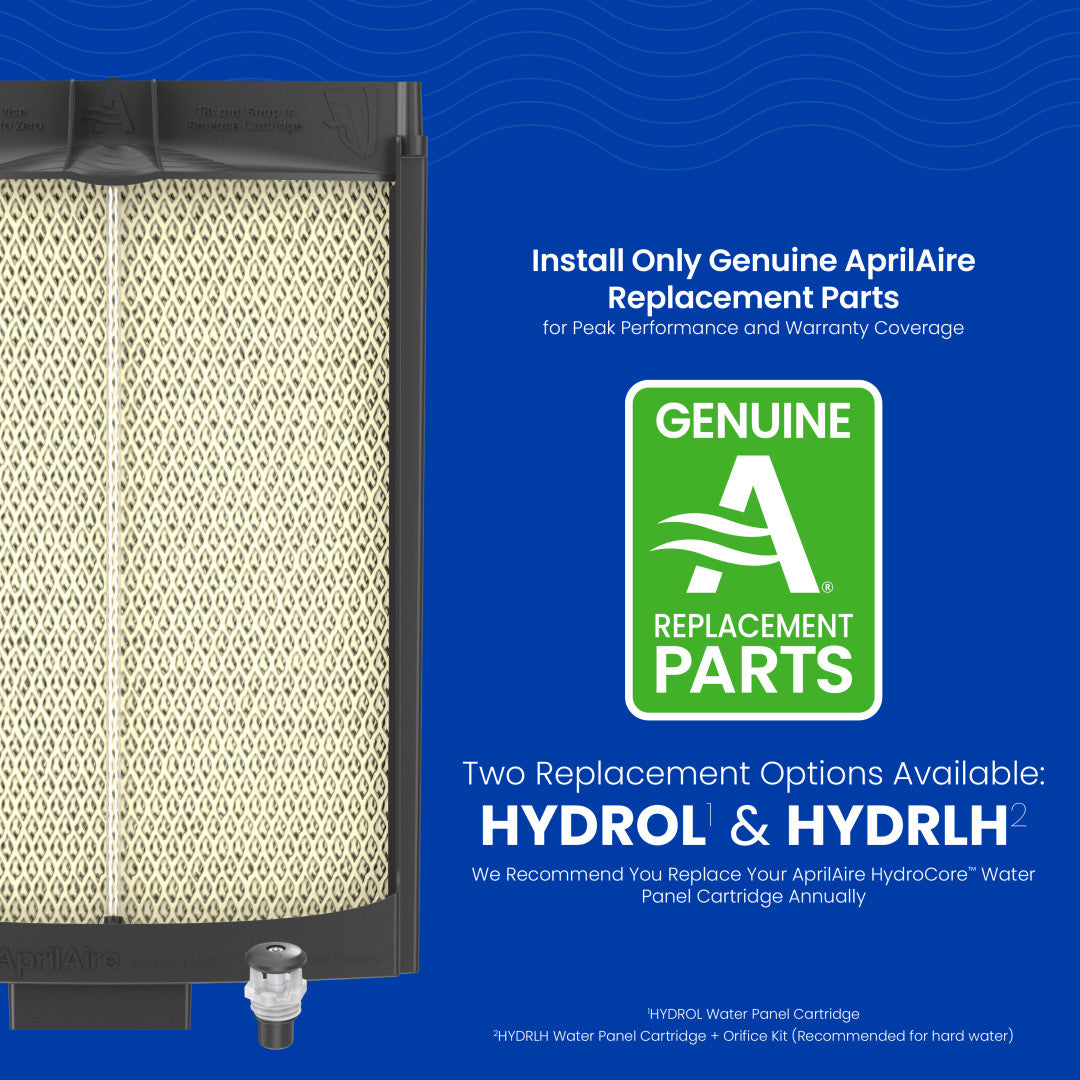
HydroCore is AprilAire's newer water panel technology, currently on the 620 and 720. Compared to the 600 and 700 it replaces, AprilAire reports better performance and efficiency, less wastewater, and simpler maintenance.
The wastewater point matters more than it sounds. Traditional drain-through evaporative humidifiers send unevaporated water down the drain continuously while running. Reducing that reduces what you pay for water all winter.
Sizing: The Part That Gets Skipped
An undersized humidifier runs constantly and never reaches the target. An oversized one is not the answer either, and neither is the number on the box.
Capacity depends on more than square footage:
- How tight the house is. A 1920s Elgin foursquare and a 2015 Gilberts colonial of identical size need very different equipment, because the older house exchanges its air with the outdoors far more often.
- Ceiling height and volume. Square footage alone misses this.
- Your heating system. Furnace type and how it runs determines how much heat is available for evaporation.
- Ductwork. Whether there is room for a bypass, and where the unit can go.
- Water supply and drain. Access to both, and whether a drainless model is the better path.
We work through all of it during the in-home assessment before recommending anything.
What Maintenance Involves
Evaporative humidifiers use a water panel, sometimes called an evaporator pad. It is a wear item. Minerals from your water collect on it over a season, and a loaded panel stops evaporating efficiently.
Plan on replacing it annually, typically at the start of heating season. Homes on hard water may need it sooner, and the Fox Valley has hard water.
Steam units use a canister rather than a panel, on a similar replacement schedule.
We handle water panel replacement as part of our annual maintenance program, which means it happens without you having to remember it.
Humidifier or Dehumidifier?
Both, usually. Illinois gives you a dry winter and a humid summer, and balanced humidity is a year-round target rather than a seasonal one.
Your air conditioner removes some moisture in summer as a byproduct of cooling, and in many homes that is enough. In homes with damp basements, or where oversized cooling equipment short cycles without dehumidifying, a whole-home dehumidifier addresses what the air conditioner cannot.
Humidity control is the third rung of our Indoor Air Quality Food Pyramid, after ventilation and filtration. It is also the rung most homeowners skip entirely.
Why Compass
A whole-home humidifier is only as good as its installation. It needs to be sized to your house, placed correctly relative to the supply and return, plumbed to a water supply, drained properly where required, and wired to a control that knows what the outdoor temperature is doing.
Done poorly, the result is a unit that never keeps up, or one that runs so aggressively it puts moisture into walls. Both happen, and neither is the equipment's fault.
Compass has been installing indoor air quality equipment across the Fox River Valley for over a decade. We are veteran-owned, based in East Dundee, and we install and service the full AprilAire line.
Frequently Asked Questions
Will a whole-home humidifier work with my system?
Almost certainly. AprilAire makes units for forced air, for boilers and radiant systems, and for homes with no ductwork at all. The question is which type, not whether.
Does it need its own water line?
Yes. Evaporative and steam units connect to your water supply. Most also need a drain, though the AprilAire 400 is drainless, which makes it useful where drainage is difficult.
How often does the water panel need replacing?
Once per heating season for most homes. Hard water may require it sooner.
Can I install one myself?
It involves cutting into ductwork, connecting to potable water, wiring to your HVAC system, and setting a control correctly. We would rather you did not, and manufacturer warranty coverage generally depends on professional installation.
Will it make my windows sweat?
Not if it is set correctly. Window condensation means the humidity is higher than your window surfaces can tolerate at the current outdoor temperature. An automatic control adjusts the target down as it gets colder, which is exactly why we recommend automatic models here.
Do I still need one with a heat pump?
Yes, and arguably more. The dryness comes from cold outdoor air being heated, regardless of what heats it. Because heat pumps deliver air at a lower temperature than a furnace, a steam unit is often the better pairing, since it does not depend on hot supply air for evaporation.
Get a Recommendation for Your Home
We will measure what your house is actually doing, look at your system and ductwork, and recommend the right unit and the right control. No pressure, no obligation, and a written proposal you keep.
Call (630) 504-8688 or request an estimate online.
Serving Elgin, South Elgin, East Dundee, West Dundee, Carpentersville, Sleepy Hollow, Gilberts, Streamwood, Bartlett, Hoffman Estates, and the surrounding Fox River Valley.